Our goal is to ensure that Vodacom is the customer
brand of choice, with a brand that reflects our core
purpose of helping everybody live a better today and
build a better tomorrow. Our brand promise is ‘power to
you’, which we will achieve by democratising Internet
access and bridging the digital divide in the
communities we serve. We strive to build trust with
our stakeholders by ensuring customer excellence
and developing a deserved reputation for being a
sustainability pioneer and a leader in transformation
and Black Economic Empowerment.
Brand and reputation leadership
Having a strong brand that clearly and consistently communicates
our core purpose, and that reflects our leadership in social
transformation and sustainability, is a critical foundation of our
Vision 2020 strategy.
This year, we have continued to drive a unified and consistent
brand across all our operations, with a key development being the
successful rebranding of our DRC operations to Vodacom’s iconic
red. The strength of the Vodacom brand, and our reputational
leadership, is demonstrated through the various external
accolades and awards that we received this year across different
markets and consumer segments:
Vodacom won the Grand Prix prize for overall favourite brand in
the Sunday Times Top Brands Awards, and was rated best
telecommunications provider in both the consumer and
business categories;
South African youth once again voted Vodacom as the ‘coolest’
telecoms provider in the Sunday Times Generation Next leading
annual youth brand preference and consumer behaviour survey;
We were rated as the second most valuable brand in South Africa
by Brand SA;
Vodacom was ranked the most reputable company in the
South African telecommunications sector, and ranked
fourth overall in the annual Mail & Guardian Top Companies
Reputation Index (TCRI); and
We were also ranked as South Africa’s most reputable company
in the telecoms sector by the 2016 RepTrak Pulse reputation
survey results released by Reputation House.
Notwithstanding this existing brand and reputation leadership, we
recognise that we cannot rest easy. It is essential that we retain a
strong focus on understanding and addressing the material
interests of our stakeholders, especially on ‘hot topics’ such as the
cost of data, rural coverage and socioeconomic transformation. As
reviewed earlier in the report (click here), we engage regularly
with stakeholders to ascertain their interests, and are
implementing various initiatives aimed at building trust with our
stakeholders, driving down the cost of data, increasing access to
digital services, and promoting social transformation.
We track Vodacom’s reputation, and levels of stakeholder trust,
through various means. In addition to monitoring NPS, we
commission an independent research company to conduct an
annual corporate Reputation survey with internal and external
stakeholders to benchmark our reputation against our
competitors in the mobile telecommunications market and
another leading brand. This year, Vodacom retained its number
one position as a reputational leader in the telecommunications
sector, with stakeholders rating us higher than our peers and other
non-telecommunications brands across all our markets.
Our Reputation Index performance
Reputation Index
2017
2016
Relative
position
South Africa
7.9^
7.5
#1
Tanzania
8.4
7.9
#1
DRC
7.5
7.6
#1
Mozambique
8.3
8.3
#1
Lesotho
8.1
8.4
#1
^
These items were the subject of the limited assurance engagement performed
by KPMG.
For more information on the methodology undertaken for this
survey, please refer to the KPI assurance definition report at
www.vodacom.com
Driving social progress through
transformational solutions
The most effective way in which we can make a positive societal
contribution is through our business activities – enhancing
connectivity by providing increased access to reliable and
affordable data and voice services. By extending the coverage and
quality of our network, facilitating access to smart devices,
developing and providing segmented customer propositions, and
maintaining a strong focus on pricing transformation, we can
make an enormous contribution to national developmental
objectives and the global UN Sustainable Development Goals.
Through our Vision 2020 strategy we are committed to removing
barriers to accessing digital services, and to harnessing recent
developments in digital technology, to play a transformative role
in financial inclusion, education, agriculture, and healthcare. We
are working in partnership with various stakeholders – including
government, technology providers, civil society organisations and
communities – to identify innovative ways in which mobile and
data technologies can make a significant social contribution in
each of these areas.
Financial inclusion: In Tanzania, the DRC, Mozambique and
Lesotho we provide affordable access to mobile banking services
to more than 12.9 million customers, many of them in remote
rural areas, through our ground-breaking M-Pesa product. While
the core benefit of M-Pesa remains the transfer of money
between customers, this has also evolved to enabling people to
save and borrow, and to receive salaries and benefits. In Tanzania,
our M-Pawa savings and loans product, delivered in partnership
with the Commercial Bank of Africa, has gained further traction
with 1.2 million customers now using the service. Our
International Money Transfer services, which enable customers
to send money between Tanzania and Kenya, are also
increasingly being used. We are further expanding M-Pesa
products to merchants across the county to offer ease of
payment at point of sale.
Education: Our free learning platform, Vodacom e-school,
provides 220 910 registered learners with content aligned with
their school’s curriculum direct to their mobile phone, tablet or
laptops. The portal is endorsed by the Department of Basic
Education and provides daily lessons, videos and assignments in the form of quizzes, as well as personalised progress reports. We
are also working in partnership with various publishers to digitise
school and university textbooks and make these available on a
zero-rated portal. In January this year, we launched our Siyakha
platform in South Africa. Focused on the emerging prepaid
segment, the platform offers very low-cost voice and data
bundles, entry-level smartphones, and targeted content
offerings, including free content on specific education, health
and employment websites. In our International operations,
through our Instant Network School initiative we have provided
millions of young people with free access to online learning
material from primary through to advanced high school level.
Agriculture: This year, we partnered with the Deutsche
Gesellschaft für Internationale Zusammenarbeit (GIZ) to launch
an IoT-based solution to support smallholder farmers in
South Africa to access the commercial agriculture arena. With an
estimated combined investment amount of around R21 million
over three years, the ‘Connected Farmer’ platform, a cloud-based
web and mobile software solution, will link thousands of
smallholder farmers to the agriculture value chain enabling
access to information, services and markets. This initiative
leverages off similar projects that we have been implementing
successfully in Tanzania and Mozambique. By connecting
enterprises, small and commercial agribusinesses, NGOs and
farmer associations, the initiative will contribute to improving
agriculture productivity, addressing food security, creating jobs
and increasing incomes in the agriculture sector.
Health: In partnership with Mezzanine we have developed
a mobile platform that allows healthcare professionals in
South Africa to utilise secure mobile devices to send treatment
plans to patients, manage patients’ medical records and monitor
the availability of medicine at the dispensaries, all in real time.
Our mobile application that we launched in partnership with the
Department of Health in 2013, has been rolled out to 3 167
health clinics across eight provinces. We have also continued
with our nationwide awareness campaign using Vodacom
technology in the ‘text-to-treatment’ approach to get the
message on HIV/Aids treatment to as many affected people as
possible. In Tanzania, we provide free text messages with
maternal health advice for pregnant women and mothers with
newborns. In partnership with USAID, we have launched a network of 100 taxi drivers to respond to toll-free emergency
calls from pregnant women needing to get to hospital, with the
drivers paid using M-Pesa. In Lesotho, we are using a text-totreatment
model to get more HIV-positive pregnant women and
children onto effective treatment programmes, with M-Pesa
facilitating patients’ transport.
Delivering value through social investment
In addition to delivering societal value through our core business
activities, we also support various initiatives and partnerships in
education, health, entrepreneurship and other areas through our
corporate social investment activities administered through the
Vodacom Foundation. This year, we invested R114 million in
community projects across our markets aimed at promoting
broader societal transformation.
The following is a selection of recent social investment projects
across our focus areas and operating regions (further information
is provided in our Sustainability report):
Through our flagship mobile education programme
(mEducation), developed in partnership with the Department of
Basic Education, we have provided ICT equipment and Internet
connectivity to 3 000 schools throughout South Africa. We have
also equipped and connected 92 teacher centres that offer
teacher development courses, youth training on ICT, and
community programmes. We have trained over 100 000
teachers on the use of ICT in the classroom.
In June 2016, Vodacom partnered with South Africa’s leading
career websites to launch the NXT LVL zero-rated career website.
This enables job seekers to browse job sites, upload their CVs
and apply for available positions free of charge.
In partnership with the United Nations High Commissioner for
Refugees’ (UNHCR) Innovation and Education units, we have
deployed our ‘Instant Classroom’ to schools in various refugee
settlements. Designed by Vodafone, the ‘digital school in a box’
comes equipped with a laptop, 25 tablets pre-loaded with
educational software, a projector, a speaker and a hotspot
modem with 3G connectivity.
Through the Vodacom Foundation we have been a long-standing
supporter of various non-profit organisations (NPOs) in the
health arena, including Ndlovu Care Group, Smile Foundation,
South African National Council for the Blind, and the Netcare
Foundation.
In 2014, in partnership with the South African Department of
Social Development, we established a 24-hour call centre
providing counselling to victims of gender-based violence; this
year, we extended its services to people with a hearing
impairment. We continue to fund various NPOs that render
critical intervention in combating gender-based violence.
In Lesotho, we have invested in a multi-year project (iSchool)
that delivers educational tablets to five primary schools in four
districts; the tablets contain approved curriculum and relevant
teaching material, from lesson plans, classroom exercises to
homework sections and homework help sections.
This year, we invested R3 million to support 12 entrepreneurs
through a 12-week incubator programme at Vodacom Lesotho’s
Innovation Park, a technology-based business incubator that
leverages the power of technology and mobile communications
to help small businesses become more competitive.
In Mozambique, we contributed R3.7 million worth of supplies
towards relief efforts following Cyclone Dineo, which devastated
Inhambane province in February 2017; we also contributed
R1.6 million to enable our customers to communicate for free
with family and friends, and distributed 10 000 treated mosquito
nets across the country.
Vodacom Change the World programme
For the past six years, Vodacom South Africa has annually selected
around 20 volunteers to work for an NPO of their choice for a year,
retaining their salary and at no cost to the volunteer or host
organisation. The volunteers have the opportunity to do
something close to their hearts while imparting their skills and
expertise to an NPO. Since its inception, Vodacom has invested
more than R35 million on project funds, salaries and grants to the
NPOs, with 100 volunteers delivering more than 100 projects.
Innovator Trust
We established the Innovator Trust in 2014 with a loan facility of
R750 million over five years at a lower than prime interest rate.
The funding is used to equip black entrepreneurs in the ICT
sectors with the necessary business skills to work with the
corporate sector. As at 31 March 2017, the Innovator Trust has
successfully incubated 53 SMEs as part of a two-year business
training programme.
Vodacom succeeds under new amended
ICT sector BBBEE codes
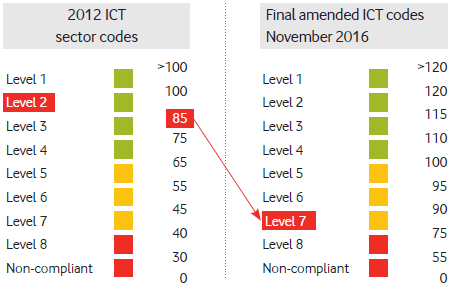
This year saw the release of the amended ICT sector BEE codes,
which was gazetted in November 2016, with the effective date
being 1 April 2016. One of the most noticeable changes is that
the scorecard BBBEE level recognition has changed materially
and, if applied without remedy, would have resulted in the
Vodacom BBBEE status dropping from Level 2 to Level 8. We have
introduced new initiatives, resulting in the Group achieving an
overall Level 4 BBBEE status for the 2017 financial year of
assessment.
Despite the various challenges, we achieved good scores across all rated elements:
Scoring element
Target points
Achieved points
Cost of investment
Ownership
25
16.17
Management control
23
14.79
Board representation
8
5.33
Other top management
5
4.33
Employment equity
10
5.13
Skills development
20
17.27
R161 million training spend on Black people
Enterprise and supplier development
50
41.68
R7 billion to >51% black-owned suppliers
Procurement
25
18.00
R5.7 billion to >30% black women-owned
Supplier development
10
8.68
R149 million on supplier development
Enterprise development
15
15.00
R399 million on SMME development
Socioeconomic development
12
12.00
R225 million on uplifting communities
Total
130
101.91
Level 4
Vodacom and the UN SDGs
The United Nations Sustainable
Development Goals (UN SDGs) set a
sustainable agenda to end poverty,
protect the planet and ensure prosperity
for all by 2030. Vodacom is committed to
playing its role, as a private sector
company, in the attainment of the goals,
supporting governments to build better
societies. Through our partnerships with
government and communities, we
continue to identify innovative ways
through which mobile communication
technologies can support financial
inclusion, food security, health and
access to education. In each of these
areas we have been able to make
significant strides in improving the lives
of our customers and the communities
we operate in. We further commit to
minimising our environmental impact.
We believe that managing our operations
responsibly and ethically will stimulate
growth and generate value for our
company, society and economy.
Vodacom and Kaduna State launch ‘ICT for
development’ initiative
In February 2017, Vodacom partnered with Kaduna State in Nigeria to launch an
‘ICT for development’ initiative that will support governance and service delivery in
healthcare, education and agriculture through the deployment of tailored ICT
solutions:
‘SMS for Life 2.0’ is a mobile-based initiative that improves healthcare delivery and
increasing the availability of medication by monitoring drug stock levels; Vodacom
is the technology partner for the public-private partnership with Novartis and
Kaduna State Ministry of Health.
We have also introduced a mobile school management solution that provides
real-time visibility of all management activities at schools; a school feeding
programme module allows the State to monitor feeding programmes at schools,
and access is also provided to real-time reports on teacher and learner data.
The next phase of our partnership with Kaduna State will focus on supporting
sustainable agriculture, through our Connected Farmer cloud-based web and
mobile solution that increases productivity by linking farmers, financial
institutions, agribusinesses and markets.
"Vodacom is taking the lead in leveraging mobile technology to address healthcare,
education and agricultural challenges in Africa. We see technology playing an
increasing role as an enabler of economic development as governments on the
continent are able to leapfrog developmental stages."
Vuyani Jarana, Chief Officer of Vodacom Business
Our Sustainability report 2017
A more detailed review of our societal impacts and contribution is
provided in Vodacom’s Sustainability report 2017. The report,
which constitutes the annual report of Vodacom’s Social and
Ethics Committee, provides information on our performance and
management approach relating to the following areas:
Sustainability governance and management: outlines our
sustainability strategy and governance framework, describes our
activities in support of the United Nations’ 17 Sustainable
Development Goals, and reviews our approach to promoting
ethical conduct and ensuring business integrity.
Engaging our stakeholders: identifies the material interests of
our key stakeholders, and our response to these interests.
Product and service responsibility: reviews our activities to
protect customer privacy and security, and address consumer
concerns.
Investing in our people: assesses our performance in
developing our people, driving employee engagement,
encouraging diversity, and promoting workplace health
and safety.
Delivering social value: reviews the societal contribution of our
products and services, our BEE performance and our corporate
social investment initiatives.
Responsible environmental management: outlines our
performance in managing our most material environmental
impacts relating to energy and climate change, water and waste.
A summary of our sustainability performance is presented in the following table:
Indicator
2017
2016
Investing in our people
Number of full-time permanent employees
7 587
7 538
Salaries and benefits (Rm)
5 428
5 599
Women representation in Executive Committee (%)
17.0
18.0
Black representation in Executive Committee (%)
58.0
55.0
Ratio of average basic salary of men to women (times)
1:3
1:3
Total training spend (Rm)
2771
103
Workplace-related fatalities
1
4
Lost-time injury frequency rate (LTIFR)
0.05
0.11
Product and service responsibility
Customer NPS (SA) (ranking relative to competitors)
1st
1st
Delivering social value
Customers (thousand)
66 785
61 305
M-Pesa customers (thousand)
12 922
9 224
Investment in infrastructure (Rm)
11 292
12 875
Total cash tax contribution (Rm)
16 082
14 710
Investment in communities (Rm)
114
106
Responsible environmental management
Direct greenhouse gas (GHG) emissions (Scope 1) (metric tonnes)
44 203
44 917
Indirect GHG emissions (Scope 2) (metric tonnes)
555 010
494 354
Indirect GHG emissions (Scope 3) (metric tonnes)
84 226
36 602
Total GHG emissions CO2 (including non-Kyoto Protocol emissions) (metric tonnes)
683 439
576 872
Access network electricity# (GWh)
333
282
Core network electricity# (GWh)
84
81
Building electricity# (GWh)
54
50
Vehicle fuel (diesel and petrol)# (million litres)
0.7
1.3
Network equipment and handsets reused/recycled# (tonnes)
69
1 006
1.
The increase on reported training spend is attributed to the application of new audit rules, i.e. contractor spend is now included.
#
South Africa only.
More detail can be found in the Sustainability report. www.vodacom.com