Our operating environment
We have identified four priority
trends in our operating
environment that have a material
impact on our ability to create value.
Vodacom’s Vision 2020 has been
developed to ensure that we are best
positioned to manage the risks and realise
the opportunities associated with each of
these issues.
Digital disruption and the connected
consumer
Digital technology is disrupting traditional business models and
significantly reshaping consumer behaviour, presenting exciting new
opportunities for value creation and a major source of business risk.
- The so-called ‘fourth industrial revolution’ is characterised by
significant developments in artificial intelligence, big data analytics
and blockchain technology, as well as the rise of connected homes,
autonomous vehicles, smart cities and the ‘Internet of Things’.
- Digitally connected consumers are changing key consumption
patterns, significantly increasing their use of data and expecting
highly personalised interactions, while at the same time being
protective of access to personal data. They are using digital
technology to become more discerning and activist customers,
sharing their experience and views rapidly across social media.
- Together, digital technologies and the connected consumer are
transforming most business sectors, challenging many traditional
assumptions about business’s relationships with customers and
employees. The digitalisation of many industry sectors presents
significant opportunities in particular for ICT companies.
- In the mobile sector, the fastest growth area is in data, driven by
increasing penetration of smartphones, wearable devices and
tablets, as well as by improved networks and the increased
availability of data content. Globally, it is anticipated that
smartphone users will double and data usage will increase by
7 to 11 times by 2020. The greatest demand for mobile services
is coming from emerging markets, where there is a young and
growing population base, faster levels of economic growth,
less fixed-line infrastructure, and low (but rapidly rising)
mobile penetration.
Implications for our strategy: To succeed in this emerging
digital era, our new strategy overtly positions Vodacom to be a
leading digital company, empowering a connected society.
Digitalisation offers valuable opportunities for us to extend
revenue streams beyond connectivity, and requires us to rethink the networks and technology of the future, redefine customer
engagement and develop a company culture that attracts the best digital talent. It also presents unparalleled opportunities to
drive positive social change in areas such as education,
healthcare, financial services and agriculture.
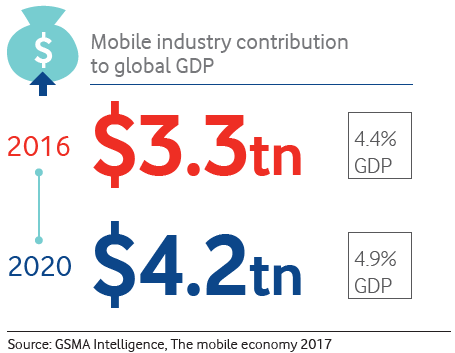
By 2020, in the global market there will be
5.7 billion 
smartphones, growth of 1.9 billion from the end of 2016.
Source: GSMA Intelligence, The mobile economy 2017
The changing landscape of competition
and collaboration
The telecommunications and mobile sector is proving
increasingly competitive, including from some non-traditional
new sources.
- In our countries of operation there are typically three to four
mobile network operators, each of which is seeking strong
competitive differentiation, through significant capital
investment in networks, a strong price play, enhancing the
customer experience for targeted segments, and/or
developing new digital offerings.
- In most markets we are seeing an increased uptake in
over-the-top (OTT) content, messaging and voice providers
who use open Internet-based communication rather than
existing operator-controlled cellular services.
- As we move towards being an overtly digital enterprise, wedatatec
are facing greater competition for new customers and
employees from various non-traditional sources. These
include new competitors, and potential collaborators, in the
provision of technology, networks and infrastructure, and in
the development and distribution of new digital products
and services.
Implications for our strategy: This growing
competition, sometimes from unexpected sources,
underlines the importance of ensuring that we are both fast
and flexible. In many instances, we recognise the benefit of
identifying opportunities for collaboration and innovative
partnerships, rather than traditional competition.
Mobile money is available in
85%
of global markets
where less than
20%
of the population has
access to a formal
financial institution.
Source: GSMA Intelligence, The mobile economy 2017
Challenging macroeconomic conditions
The challenging macroeconomic and market environment in each
of our operating countries is impacting consumer disposable
income, revenue growth and operating costs.
- In South Africa, our largest market, the impact of the drought on
the agriculture sector and flat GDP growth rates have weakened
already poor employment opportunities and dented consumer
spending. Business confidence continues to be impacted by
political and policy uncertainty, and concerns regarding further
rating downgrades.
- In our other operations, consumer spending-power has been
affected by rising taxes and interest rates, local exchange rate
depreciation, and a general increase in the cost of living. Sharply
depreciating currencies – particularly in Mozambique and
Nigeria – have widened exposure to foreign-denominated
expenses, impacting the rollout of low-cost devices, and
resulting in higher operating costs. Cost-efficiency measures
have been further constrained by inflationary pressures,
particularly in terms of wages and energy costs.
Implications for our strategy: These continuing
challenges in macroeconomic indicators highlight the
importance of maintaining a strong efficiency drive, which we
have delivered through our cost-efficiency programme, as well
as providing targeted products and services across consumer
income groups. A key focus of our new strategy is on
developing segmented propositions, including specifically for
low-spend customers through initiatives such as Siyakha,
which seeks to promote digital inclusion in the emerging
prepaid segment.
Increasing regulatory intervention and continuing policy uncertainty
We continue to engage with regulators across our operations, on
challenges that could impact revenue growth and cost efficiency.
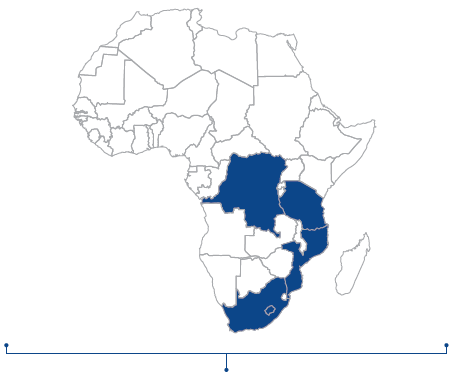
Key regulatory and policy developments (by country) include:
gg South Africa:
- South Africa: The National Integrated ICT Policy White Paper;
deferring the ‘Invitation to Apply’ for licensing of spectrum bands
pending administrative judicial review proceedings; and the
amended ICT Sector BEE Codes.
- Tanzania: Mandatory listing requirements; national security and
customer SIM registration regulations; mobile financial services
licences and regulations; new taxation requirements; quality
of service regulations; and spectrum auction planned by end
of 2017.
- DRC: Communications Bill introducing changes to licence regimes;
national security and customer SIM registration regulations;
price floor and MTR regulation; temporary social media ban;
environmental approvals; and new taxation requirements.
Mozambique: Communications Act introducing changes to
licence regimes; renewal of our 2G licence; spectrum auctions;
national security and customer SIM registration regulations;
and a review of mobile termination rates.
- Mozambique:Communications Act introducing changes to
licence regimes; renewal of our 2G licence; spectrum auctions;
national security and customer SIM registration regulations;
and a review of mobile termination rates.
- Lesotho: Renewal of mobile service licence; approval of M-Pesa G2
hosting; quality of service regulations; cybersecurity legislation; SIM
registration regulations and mobile financial services regulations.
Further details on these legislative and policy developments are
available in our country performance reports.
Implications for our strategy: Anticipating, informing and
responding to regulatory and policy developments requires
that we maintain a strong focus on developing positive and
constructive relationships with government and regulators.