Independent auditor’s report on the consolidated annual financial statements
To the shareholders of Vodacom Group Limited
Our opinion
In our opinion, the consolidated financial statements present fairly, in all material respects, the consolidated financial position of Vodacom Group Limited (the Company) and its subsidiaries (together the Group) as at 31 March 2017, and its consolidated financial performance and its consolidated cash flows for the year then ended in accordance with International Financial Reporting Standards and the requirements of the Companies Act of South Africa.
What we have audited
Vodacom Group Limited’s consolidated financial statements set out on Consolidated income statement to Notes to the consolidated annual financial statements comprise:
Basis for opinion
We conducted our audit in accordance with International Standards on Auditing (ISAs). Our responsibilities under those standards are further described in the Auditor’s responsibilities for the audit of the consolidated financial statements section of our report.
We believe that the audit evidence we have obtained is sufficient and appropriate to provide a basis for our opinion.
Independence
We are independent of the Group in accordance with the Independent Regulatory Board for Auditors’ Code of Professional Conduct for Registered Auditors (IRBA Code) and other independence requirements applicable to performing audits of financial statements in South Africa. We have fulfilled our other ethical responsibilities in accordance with the IRBA Code and in accordance with other ethical requirements applicable to performing audits in South Africa. The IRBA Code is consistent with the International Ethics Standards Board for Accountants Code of Ethics for Professional Accountants (Parts A and B).
Our audit approach
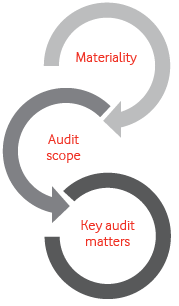 |
|
Overall Group materiality
Overall Group materiality: R960 million, which represents 5% of profit before tax. |
| |
Group audit scope
We identified two local operations, which in our view, required an audit of their complete
financial information, due to their size and risk characteristics. We have also identified an
additional operation where limited specified procedures were performed by the component
auditor owing to the operation’s contribution to the International reportable segment. |
| |
Further specified audit procedures over central functions and areas of significant judgment,
scope
including taxation, goodwill, treasury, material provisions, consolidation entries and
contingent liabilities, were performed at a Group level. |
| |
Key Audit Matters
- Revenue recognition – accuracy of revenue recorded given the complexity of products and matters systems;
- Provisions and contingent liabilities include taxation related matters; and
- Capitalisation of assets and the assessment of useful lives and residual values for property, plant and equipment, and intangible assets.
|
As part of designing our audit, we determined materiality and assessed the risks of material misstatement in the consolidated financial statements. In particular, we considered where the directors made subjective judgements; for example, in respect of significant accounting estimates that involved making assumptions and considering future events that are inherently uncertain. As in all of our audits, we also addressed the risk of management override of internal controls, including among other matters, consideration of whether there was evidence of bias that represented a risk of material misstatement due to fraud.
Materiality
The scope of our audit was influenced by our application of materiality. An audit is designed to obtain reasonable assurance whether the financial statements are free from material misstatement. Misstatements may arise due to fraud or error. They are considered material if individually or in aggregate, they could reasonably be expected to influence the economic decisions of users taken on the basis of the consolidated financial statements.
Based on our professional judgement, we determined certain quantitative thresholds for materiality, including the overall Group materiality for the consolidated financial statements as a whole as set out in the table below. These, together with qualitative considerations, helped us to determine the scope of our audit and the nature, timing and extent of our audit procedures and to evaluate the effect of misstatements, both individually and in aggregate on the financial statements as a whole.
| Overall Group materiality |
|
|
R960 000 000 |
| How we determined it |
|
|
5% of profit before tax |
| Rationale for the materiality benchmark applied |
|
|
We chose profit before tax as the benchmark because, in our view, it is the benchmark
against which the performance of the Group is most commonly measured by users, and it is
a generally accepted benchmark. We chose 5% which is consistent with quantitative
materiality thresholds used for profit-oriented companies in this sector. |
How we tailored our Group audit scope
We tailored the scope of our audit to ensure that we performed enough work to enable us to give an opinion on the consolidated financial statements as a whole, taking into account the geographic structure of the Group, the accounting processes and controls including those performed at the Group’s shared service centres, and the industry in which the Group operates.
The Group’s main operating subsidiaries are located in five countries across the African continent. In establishing the overall approach to the Group audit, we determined the type of work that needed to be performed at the local operations by us, as the Group engagement team, or component auditors from other PwC network firms operating under our instruction. Where the work was performed by component auditors, we determined the level of involvement we needed to have in the audit work at those local operations to be able to conclude whether sufficient appropriate audit evidence had been obtained as a basis for our opinion on the consolidated financial statements as a whole.
The Group’s local operations vary in size. Two operations were identified as “in full-scope” for Group audit reporting purposes (Vodacom (Pty) Limited and Vodacom Tanzania Public Limited Company) representing 79.6% and 7.3% of the Group’s revenue and 96.1% and 2.4% of the Group’s profit before tax. We identified these two local operations as those that, in our view, required an audit of their complete financial information, due to their size and risk characteristics. In addition, Vodacom Congo (RDC) SA has been included “in-scope” for limited specified procedures owing to the operation’s contribution to the International reportable segment.
Specified audit procedures over certain balances and transactions relating to operations identified as “out-of-scope” for Group audit reporting were performed to give appropriate coverage of all material balances at both geographical division and Group levels.
Further specified audit procedures over central functions and areas of significant judgement, including taxation, goodwill, treasury, material provisions, consolidation entries and contingent liabilities, were performed at the Group’s Head Office in Midrand, South Africa. In addition, audits for local statutory purposes are performed for the subsidiaries “not in-scope” for Group auditing reporting. Where possible, the timing of local statutory audits was accelerated to align to the Group audit timetable, and where relevant significant findings were reported to the Group engagement team.
The Group engagement team visited the two operations “in-scope” for Group audit reporting during the audit cycle and the lead audit partner attended the year-end audit clearance meetings of those operations.
Key audit matters
Key audit matters are those matters that, in our professional judgement, were of most significance in our audit of the consolidated financial statements of the current period. These matters were addressed in the context of our audit of the consolidated financial statements as a whole, and in forming our opinion thereon, and we do not provide a separate opinion on these matters.
| |
The accuracy of amounts recorded as revenue is an inherent industry risk due to the complexity of billing systems, accounting for new products and plans – including multiple element arrangements – and the combination of products sold and tariff structure changes during the year.
Furthermore, the partial migration of post-paid customers in the South African operations to the Customer 3D IT system environment has been a matter of most significance during the current year audit due to the risks relating to data migration between the new and legacy billing platforms and the complexity inherent in the first-year implementation of the new system.
The application of revenue recognition accounting standards is complex and involves a number of judgements and estimates.
Refer to Critical accounting judgements including those involving estimations. |
|
We have understood and tested management’s controls over the transfer of revenue information between the multiple systems involved in recording revenue. Included in these controls we have specifically tested the controls in place over the authorisation of rate changes, the introduction of new products and the input of this information to the billing systems.
We utilised our Information Technology (IT) specialists to test the IT general and automated controls of the relevant billing environments, as well as to assess the relevant revenue reports utilised for audit purposes.
Furthermore, our IT specialists tested management’s controls over the transfer of post-paid customer data for South African customers from legacy billing systems to the new Customer 3D billing environment.
We examined and assessed the accounting policies applied in the recognition of revenue for compliance with IFRS and industry guidance. To assess the appropriate application of the agent versus principal accounting treatment for different post-paid revenue transactions, we examined legal documents and business rules between the Group and its business partners and did not identify any contradictions from those applied by management.
Our substantive procedures included, among others, the following:
- testing the end-to-end reconciliation from billing systems to the manual journals captured in the general ledger to assess the completeness and accuracy of revenue recorded. Our procedures also included testing samples of prepaid and hybrid data tariffs to an authorised price list. No material differences were identified in performing these substantive tests; and
- testing of the allocation of the revenue to the various elements in the multiple element arrangements in order to assess the accuracy of the deferred revenue and deferred commission calculations. No material differences were noted in performing these substantive tests.
|
|
|
|
|
| |
There are a number of pending and actual legal and regulatory cases against the Group. Accordingly, management exercises a high level of judgement in estimating the level of provisioning required. The evaluation of management’s judgements, including those that involve estimations in assessing the likelihood that a pending claim will succeed, or a liability will arise, and the quantification of the ranges of potential financial settlement have been a matter of most significance during the current year audit.
Furthermore, the Group has operations across a number of jurisdictions and is subject to periodic challenges by local tax authorities. Evaluation of the outcome of the taxation related matters, and whether the risk of loss is remote, possible or probable, requires significant judgement by management given the complexities involved.
Refer to Critical accounting judgements including those involving estimations, – Provisions,
– Contingent liabilities and legal proceedings and – Taxation. |
|
Our procedures included, among others, the following:
- testing management’s relevant controls surrounding litigation and regulatory compliance;
- obtaining confirmation, where appropriate, from relevant third party legal representatives and conducting direct discussions with them regarding material cases. The results of the circularisation were found to be consistent with the representations made by management relating to legal, taxation and regulatory compliance matters;
- reading Group legal reports, discussing open legal matters with the Group general counsel, regulatory, and tax teams – and where relevant – reading external legal opinions obtained by management. The outcomes of these procedures were found to be consistent with the representations obtained from management; and
- involving our tax specialists to assess management’s application and interpretation of tax legislation affecting the Group, and to consider the quantification of exposures and settlements arising from disputes with tax authorities in the various tax jurisdictions.
Based on the evidence obtained, while noting the inherent uncertainty with such legal, regulatory and tax matters, we accepted the level of provisioning at 31 March 2017 and noted that it is at a level consistent with previous years. |
|
|
|
|
| |
Property, plant and equipment and intangible assets represent a significant proportion of the Group’s asset base, being 60.8% of the Group’s total assets. The estimates and assumptions made to determine the carrying amounts, including whether and when to capitalise or expense certain costs, and the determination of depreciation and amortisation charges are material to the Group’s financial position and performance. The charges in respect of periodic depreciation and amortisation are derived after estimating an asset’s expected useful life and the expected residual value. Changes to assets’ carrying amounts, expected useful lives or residual value could result in a material impact on the financial statements and have been a matter of most significance during the current year audit.
Refer to Significant accounting policies for property, plant and equipment, intangible assets, critical accounting judgements including those involving estimations of useful lives and residual values as well as – Property, plant and equipment and – Intangible assets. |
|
We obtained an understanding of, and tested the relevant management controls relating to the capitalisation of property, plant and equipment and intangible assets, and the controls relevant to the review of useful lives and residual values.
We evaluated the capitalisation policies and assessed the timeliness of the transfer of assets under construction. We found no exceptions from the sample of items tested.
Our detailed substantive testing of the determination of asset useful lives and residual values identified no exceptions. In performing these procedures we considered management’s judgements, including the appropriateness of existing and revised asset lives and residual values applied in the calculation of depreciation and amortisation to determine whether these judgments reflected technological developments within the telecoms industry and changes in the anticipated duration of use by management. We further tested whether approved asset life revisions were appropriately applied to the fixed asset register. |
Other information
The directors are responsible for the other information. The other information comprises the directors’ report, the report of the Audit, Risk and Compliance Committee, the Certificate by the Company Secretary as required by the Companies Act of South Africa, the Directors’ statement of responsibility and the Summarised Company financial statements of the consolidated annual financial statements for the year ended 31 March 2017, which we obtained prior to the date of this auditor’s report and the Vodacom integrated report for the year ended 31 March 2017, which is expected to be made available to us after the date of this auditor’s report. Other information does not include the consolidated financial statements and our auditor’s report thereon.
Our opinion on the consolidated financial statements does not cover the other information and we do not and will not express an audit opinion or any form of assurance conclusion thereon.
In connection with our audit of the consolidated financial statements, our responsibility is to read the other information identified above and, in doing so, consider whether the other information is materially inconsistent with the consolidated financial statements or our knowledge obtained in the audit, or otherwise appears to be materially misstated.
If, based on the work we have performed on the other information that we obtained prior to the date of this auditor’s report, we conclude that there is a material misstatement of this other information, we are required to report that fact. We have nothing to report in this regard.
Responsibilities of the directors for the consolidated financial statements
The directors are responsible for the preparation and fair presentation of the consolidated financial statements in accordance with International Financial Reporting Standards and the requirements of the Companies Act of South Africa, and for such internal control as the directors determine is necessary to enable the preparation of consolidated financial statements that are free from material misstatement, whether due to fraud or error.
In preparing the consolidated financial statements, the directors are responsible for assessing the Group’s ability to continue as a going concern, disclosing, as applicable, matters related to going concern and using the going concern basis of accounting unless the directors either intend to liquidate the Group or to cease operations, or have no realistic alternative but to do so.
Auditor’s responsibilities for the audit of the consolidated financial statements
Our objectives are to obtain reasonable assurance about whether the consolidated financial statements as a whole are free from material misstatement, whether due to fraud or error, and to issue an auditor’s report that includes our opinion. Reasonable assurance is a high level of assurance, but is not a guarantee that an audit conducted in accordance with ISAs will always detect a material misstatement when it exists. Misstatements can arise from fraud or error and are considered material if, individually or in the aggregate, they could reasonably be expected to influence the economic decisions of users taken on the basis of these consolidated financial statements.
As part of an audit in accordance with ISAs, we exercise professional judgement and maintain professional scepticism throughout the audit. We also:
- Identify and assess the risks of material misstatement of the consolidated financial statements, whether due to fraud or error, design and perform audit procedures responsive to those risks, and obtain audit evidence that is sufficient and appropriate to provide a basis for our opinion. The risk of not detecting a material misstatement resulting from fraud is higher than for one resulting from error, as fraud may involve collusion, forgery, intentional omissions, misrepresentations, or the override of internal control.
- Obtain an understanding of internal control relevant to the audit in order to design audit procedures that are appropriate in the circumstances, but not for the purpose of expressing an opinion on the effectiveness of the Group’s internal control.
- Evaluate the appropriateness of accounting policies used and the reasonableness of accounting estimates and related disclosures made by the directors.
- Conclude on the appropriateness of the directors’ use of the going concern basis of accounting and, based on the audit evidence obtained, whether a material uncertainty exists related to events or conditions that may cast significant doubt on the Group’s ability to continue as a going concern. If we conclude that a material uncertainty exists, we are required to draw attention in our auditor’s report to the related disclosures in the consolidated financial statements or, if such disclosures are inadequate, to modify our opinion. Our conclusions are based on the audit evidence obtained up to the date of our auditor’s report. However, future events or conditions may cause the Group to cease to continue as a going concern.
- Evaluate the overall presentation, structure and content of the consolidated financial statements, including the disclosures, and whether the consolidated financial statements represent the underlying transactions and events in a manner that achieves fair presentation.
- Obtain sufficient appropriate audit evidence regarding the financial information of the entities or business activities within the Group to express an opinion on the consolidated financial statements. We are responsible for the direction, supervision and performance of the Group audit. We remain solely responsible for our audit opinion.
We communicate with the directors regarding, among other matters, the planned scope and timing of the audit and significant audit findings, including any significant deficiencies in internal control that we identify during our audit.
We also provide the directors with a statement that we have complied with relevant ethical requirements regarding independence, and communicate with them all relationships and other matters that may reasonably be thought to bear on our independence, and where applicable, related safeguards.
From the matters communicated to the directors, we determine those matters that were of most significance in the audit of the consolidated financial statements of the current period and are therefore the key audit matters. We describe these matters in our auditor’s report unless law or regulation precludes public disclosure about the matter or when, in extremely rare circumstances, we determine that a matter should not be communicated in our report because the adverse consequences of doing so would reasonably be expected to outweigh the public interest benefits of such communication.
Report on other legal and regulatory requirements
In terms of the IRBA Rule published in Government Gazette Number 39475 dated 4 December 2015, we report that PricewaterhouseCoopers Inc. has been the auditor of Vodacom Group Limited for three years.
PricewaterhouseCoopers Inc.
Director: DB von Hoesslin
Registered Auditor
Pretoria
2 June 2017


