Downloads
Our business
Our performance
Governance review
Other
- BEE certificate
- Corporate environmental policy
- ISO 14001 certificate
- KPI assurance definitions report

Our business
Our performance
Governance review
Other
We strategically prepare for the impacts described below by ensuring that our products and offers provide value across our customer base, while continuously driving improved value to our customers.
We have experienced tougher macroeconomic and market environments across our operating countries. Real GDP growth estimates1 for 2016 in each of the countries were as follows: South Africa 0.4%, Tanzania 6.5%, the DRC 5.0%, Mozambique 4.2%, Lesotho 2.0%, Nigeria 2.1% and Zambia 3.1%. Although GDP growth was suppressed across our operations, countries are still delivering a reasonable growth rate. Most countries have, however, been impacted by larger than normal local exchange rate depreciation, which has in turn caused rising inflation, higher interest rates and increased taxation. Collectively, this has resulted in depressed consumer spending. We have sought to counter this through the introduction of more relevant products that provide personalised value to our customers. In South Africa, business and consumer confidence has been very low throughout the year. Although the sharp depreciation in currencies has put pressure on our foreign denominated cost base, we have successfully managed to weather this impact through our ‘Fit for growth’ cost-cutting programme. The stability of the currencies going forward remains a risk.
1. Bureau for Economic Research (BER) and the Economist Intelligence Unit (EIU).
South Africa Consumer Confidence Index
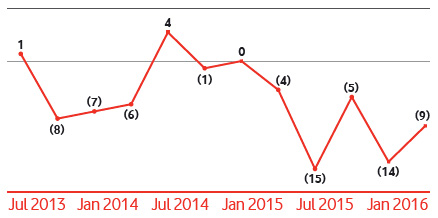
Source: Bureau for Economic Research (BER).
We continue to face important regulatory changes and potential
policy uncertainty across our operations, with implications both
for revenue growth and cost efficiency: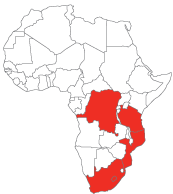
All our markets are subject to mobile customer registration requirements, the industry is engaging with authorities to improve the process to ensure registration. Difficulties experienced in the registration process include: limited number of national identity cards; the inefficiency of a paper-based process; and the inability of mass-market distribution partners to complete the registration processes correctly. Tanzania and Mozambique have replaced the paper-based process with an electronic registration process. We are continuing to actively register customers, work with authorities to improve verification of customer registration information, and have action plans in each country to achieve full compliance.

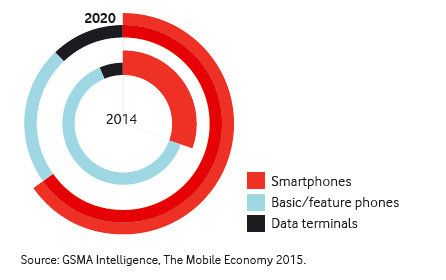
The global mobile telecoms sector is experiencing some significant shifts, both in the composition of its customer base and the nature of consumer expectations. The greatest demand for mobile services is coming from emerging markets which have a young and growing population base, faster levels of economic growth, less fixed-line infrastructure, and low (but rapidly rising) mobile penetration. Across all markets, the fastest growth area is in data, driven by increasing penetration of smart devices, improved networks and an increased availability of data content, as individual consumers and enterprises move to a more connected, digital lifestyle as part of the IoT. Meeting the significant potential for data growth in the emerging market context (where disposable income is lower, there is increasing competition and growing regulatory pressure) will require a strong focus on appropriate pricing models, innovative products, service and distribution channels, and a continuing drive for greater cost efficiency.
Smartphone connections in developing regions
The mobile sector is highly competitive and faces significant levels of disruption. In each of our countries of operation there are typically two to four mobile network operators (MNOs). In some instances, new MNOs seeking to gain market share are driving unsustainable price reductions that, arguably, are harming the sector’s longer-term strength. In addition, there are small operators who hold spectrum providing fixed mobile substitution products, and a few mobile virtual network operators (MVNOs) who provide services on top of existing networks. There is also an increasing role of over-the-top (OTT) content, messaging and voice providers, who use open internet-based communication rather than existing operator-controlled cellular services. This growing competition, sometimes from unexpected sources, underlines the importance of maintaining a strong culture of innovation and a high adaptive capacity across the company.
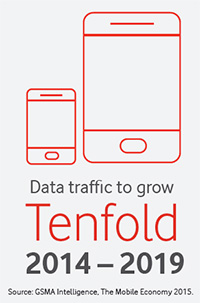
Our markets continue to be competitive, with continuing regulatory and macroeconomic risks. Looking to the year ahead, we anticipate ongoing GDP growth but sluggish growth in consumer expenditure growth as consumers attempt to manage increased cost of living, compounded by weak exchange rates. Despite this outlook, we remain confident that our network and customer experience investments will continue to differentiate us and translate into further customer and revenue growth, especially in the areas of data consumption.
