Downloads
Our business
Our performance
Governance review
Other
- BEE certificate
- Corporate environmental policy
- ISO 14001 certificate
- KPI assurance definitions report

Our business
Our performance
Governance review
Other

Globally, we are seeing a rapid technology migration to higher-speed mobile broadband networks and the increasing adoption of smartphones and other connected devices as part of a move to the ‘Internet of Things’. Collectively, this is driving substantial growth in data traffic. Mobile is at the heart of the new digital ecosystem; GSMA 2015 has predicted that in the period to 2020, mobile’s contribution to global GDP will grow at a faster rate than the rest of the global economy. This brings significant opportunities, as well as some important challenges, associated in particular with the rapidly changing nature of competition in this area. To build resilient revenue streams and secure future growth opportunities, we are investing indiversifying our business across a range of focus areas.




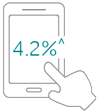
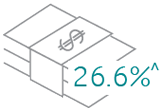
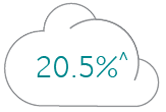
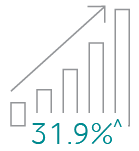
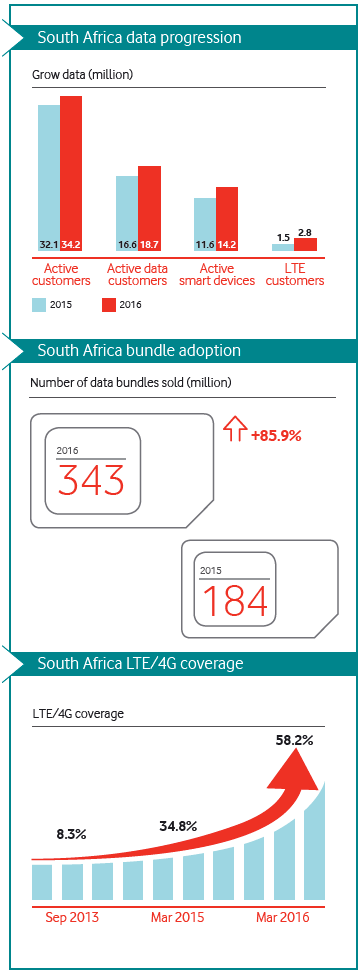
Only 56.9% of our total active customers are currently using data. In South Africa, only 47.1% of active devices on our network are smart data devices; there are substantial opportunities for data revenue growth within our existing customer base. There is also significant potential to extend this customer base, particularly in our International operations where there is low, but rapidly growing, mobile penetration.
Our strategy for growing data revenue is predicated on four pillars: having the best network; getting a device fit for customer specific needs into every customer’s hands; offering affordable value across all segments; and providing more reason to consume data through the provision of content. We have seen encouraging performance this year in each of these areas:
We are continuing to identify new opportunities to grow revenue through the provision of new services in some of our non-traditional areas such as mobile financial services, insurance, IoT, fibre to the home and business and content. We have established dedicated acceleration units to drive further uptake in each of these areas.
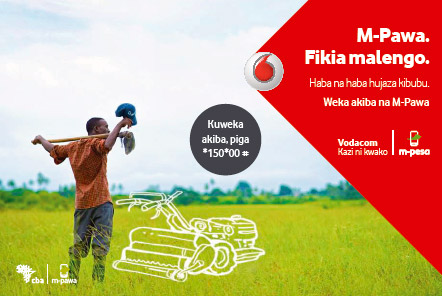
Our M-Pesa mobile money initiative remains a strong growth driver in our International operations, with active customers up 15.4% to 9.2 million. In Tanzania, our partnership with Commercial Bank of Africa to introduce M-Pawa, the country’s first mobile savings and loans product, has shown good results. Launched in September 2014, we now have 1.6 million customers actively using M-Pawa services. There has also been steady uptake of our International Money Transfer (IMT) services, which we are looking to expand further. Unfortunately in South Africa, our progress with M-Pesa has been much slower than anticipated. This is in part due to a very high banking penetration, the regulatory environment, challenges in distribution and customer uptake. As a result, we have taken the decision to terminate our M-Pesa service offering in South Africa, but remain committed to expanding this service further in our other markets.
We have developed various short-term insurance and long-term
insurance products. These include life and funeral insurance, and
device insurance offerings, with different offerings targeting specific
segments of the market. This year, we launched screen insurance
and are seeing a very good uptake. We also launched prepaid
funeral insurance where customers can use their prepaid wallet to
pay. Our insurance portfolio has grown steadily, generating revenue
this year of approximately
R524 million, an increase of 18.8% on
last year. Revenue from our long-term insurance business grew
123.8% off a small but fast-growing base. Only 500 000 of our
contract customers currently have device insurance, which leaves
significant opportunity for growth in this offering. We are also
focusing on scaling up our funeral and life insurance business,
leveraging off our strong brand and customer base.
This year, our IoT connections grew 28.2% to 2.4 million, providing 20.7%1 revenue growth across various different IoT offerings to our customers. The growth is fuelled by increased digitization of key value chains and operations, ranging from point of sale systems, smart metering and retail systems to usage-based insurance (UBI) services. The most valuable potential of IoT lies in the application of technology to deliver social progress at scale. Although the principal focus for IoT has been in South Africa, we will be extending these into our International operations, having made good initial progress in Tanzania. We are also extending the trading network to include the informal sector, within a sound economic model. Vodafone’s position as the global market leader in IoT, and its extensive resources in Africa – such as its dedicated IoT platform, its automotive capabilities and its remote monitoring and control services platform – provide us with a unique differentiator which has proved beneficial in securing several highly competitive bids for large-scale IoT connectivity rollouts.
1. Growth normalised for consolidation of X-Link in the prior year.
The rollout of fibre forms an important part of our growth strategy, and will be critical to realising the full potential associated with the increasing move to a digital-based economy. Our progress this year in rolling out fibre has been slower than anticipated, as we develop the systems and skills needed to deal with a very different business model to our traditional mobile-based suite of products and services. At year end, we had 17 384 endpoints passed and 1 223 billed endpoints. During the year, we connected 100 estates/business parks, and are currently rolling out a further 75 estates/business parks, with a total count of 15 242 fibre customers in these estates/business parks. Despite the setback with the recent termination of the Neotel deal, we continue to anticipate significant growth in this area as we implement our strategy based on wholesale, self-build and co-build.
We see valuable opportunity in using content – such as music streaming, gaming, TV and video, news or sport – to drive an increase in data uptake and revenue. In addition to driving data sales, the distribution of content provides the opportunity to grow service revenue such as billing content and in-app purchases to a user’s account, as well as providing the infrastructure to service providers to distribute their services. In implementing our reseller strategy, we have developed valuable partnerships with content providers, and are focusing on forging further partnerships in the year ahead. We are also ensuring effective synergies for content delivery associated with our key sporting sponsorships.
Enterprise has had a particularly good year, benefiting from a comprehensive enterprise transformation strategy that was initiated three years ago. The enterprise transformation programme has comprised various elements, including, but not limited to, investment in infrastructure, the development of new products, services and support systems, and the provision of the skills needed to meet the demands of the next generation enterprise. Through these initiatives, our fixed-line and managed services business in South Africa grow by 26.5% year-on-year, comprising 14.9% of the total enterprise service revenue.
This growth has been spurred by the increased demand for fixed services – particularly our IP-VPN and cloud and hosting services – as enterprises begin to migrate to the cloud at an accelerated rate. Better economics, increasing digitization of the economy, and technology transitions are further driving the adoption of cloud services. The demand for data centre capacity driven by big data, and the transition of enterprise resource planning (ERP) systems such as SAP to new SAP HANA platforms has resulted in Vodacom Business acquiring more customers to the cloud infrastructure. To be able to provide managed cloud services to very large enterprises, we have partnered with IBM to build an industrial-scale cloud infrastructure, through IBM’s 46th Cloud Managed Services point of delivery (POD) for Africa and Middle East. Combined with our investment in undersea cable capacity, this infrastructure gives us the capability to deliver cloud services at scale across Africa, enabling multinationals to build a single ERP delivered into multiple geographies. The quality of our transport network is such that the latency between Lagos and Cape Town is the same as that between Cape Town and Johannesburg. This is significant, given that applications are sensitive to the latency of transmission networks. We recognise that most customers still have their own data centre infrastructure that they may want to continue to utilise, while taking additional workloads to our cloud and hosting infrastructure. Through our 51% shareholding in Stortech, a Cisco Gold partner that specializes in the management of private data centres, we are able to give our customers the benefit of both environments.
We are focused on partnering with our clients to deliver innovative solutions in key industry verticals. Through our product and services innovations we are expanding the role of ICT beyond that of an enabler for economic development to become a significant part of industry value chains. We are integrating key value chains such as education, healthcare and agriculture, unlocking value for all stakeholders in the ecosystem. In agriculture, for example, we are linking smallholder farmers to large retail off-takers and agricultural input providers, enabling access to markets and creating a value-based ecosystem.
Our enterprise mobility management and security solutions are changing the notion of work, from being ‘where people go’ to ‘what people do, anywhere, anytime, through any device’. We advise our clients on mobility policy management, assisting them to gain greater productivity and achieve better employee engagement. Enterprise mobility will be a significant contributor to growth in mobile data and in value-added services. We have continued to invest in network security, data security and mobile device security capabilities to enable us to host applications for enterprise customers in a scalable and secure environment.
In South Africa, we also see significant growth opportunities in the SME sector. Most SMEs remain underserved in terms of high-speed broadband, with fixed-line services at under 7% penetration. To meet this need we have launched a suite of smart broadband access products; these include broadband connectivity through LTE/4G, wireless and fibre. We have been developing various new propositions to address the specific needs of the SME segment. Our product strategy for SMEs is based on segmented propositions, geared at enabling SMEs to be confidently connected, achieve greater productivity gains and grow their businesses by enabling access to markets. One such proposition is the Vodacom Hospitality Solution (powered by Nightsbridge), which aims to connect bed and breakfast customers with global booking engines to increase occupancy rates. To achieve further success in this segment, we will continue to strengthen our indirect channel and dramatically reduce our mean time to fulfil SME customer orders.
Despite the challenging business context in most African countries – characterised by slow economic growth, low commodity prices and weaker local currencies – multinational corporations and global enterprises continue to look for quality ICT multi-country services across the continent. Vodacom Business is serving this market segment consistently, with our pan African IP-VPN footprint covering 30 countries through direct points of presence. This has contributed to the 16.6% year-on-year growth in service revenue by Vodacom Business Africa. Integration with the Vodafone Global Enterprise Unit has enabled Vodacom Business to achieve greater success by better serving the multinational segment.
Our International operations continue to increase their contribution to the Group. At year end, we had 27.1 million customers from our operations outside South Africa, representing 44.2% of the Group’s total active customers. International service revenue contributed 26.6% to Group service revenue, up from 24.6% last year, while the contribution of data revenue to service revenue increased from 19.9% to 22.6%. The growth in data has been fuelled by our R4.1 billion investment in network infrastructure across the International operations, coupled with our strong focus on boosting customer experience. Strict regulatory requirements relating to subscriber registration in most of the regions have impacted negatively on levels of customer growth. We have processes in place to ensure full compliance with these requirements. We are looking to secure further customer growth through our strong focus on customised product offerings and by enhancing the customer experience through our CARE initiative.
Given the current low levels of data penetration in the region, our rapidly expanding 3G coverage, and a large and growing youth population that is becoming increasingly urbanised, we see exciting growth potential. With only 34.0% of customers currently using M-Pesa there are substantial opportunities to increase M-Pesa penetration across the region, along with other financial and related services. In Tanzania, where we have achieved scale in the number of M-Pesa users, we are exploring opportunities to grow our more sophisticated financial services products such as M-Pawa and IMT services. We will also be seeking to realise the significant opportunities associated with driving our Enter


